
The Hidden Cost of Sales Role-Play (And Why AI Does It Better)
Ask any sales leader how their team practices, and the answer is almost always the same: role-play. Pair up, one plays the prospect, one runs the pitch, debrief afterward. It's the default. It's been the default for decades.
And most sales leaders, if you push them, will quietly admit it doesn't work very well.
Not because the idea is wrong. Practicing a sales conversation before you're in a real one is obviously better than not practicing. The problem is the execution, the specific conditions under which role-play happens in most sales teams make it far less useful than it should be. The gap between what role-play is supposed to do and what it actually produces is where most sales training investment quietly disappears.
The Performance Problem
When a rep knows they're being evaluated — by a manager, by a peer, by anyone whose opinion of them matters — they don't practice. They perform.
This is not a character flaw. It's a predictable human response to social evaluation. The rep brings their most polished version of the pitch. They don't fumble the value proposition. They don't go blank when pushed on pricing. They navigate the scenario with a level of composure and preparation that often has nothing to do with how they'll show up in an actual sales call with a real prospect, real pressure, and real consequences.
The result is that the feedback collected during role-play is calibrated to the wrong input. You're evaluating the best-case version of the rep, not the version that's actually losing deals. The problems you'd want to identify — the habits under pressure, the weak responses to difficult objections, the tendency to rush to pricing before building value — don't surface cleanly in a performance environment. They stay hidden until the next real deal goes quiet.
Compounding this, feedback from colleagues is almost always softened. No one wants to tell a teammate that their discovery questions are shallow or that they sound defensive when challenged on price. The social dynamics of a team push post-role-play feedback toward the diplomatic and the vague. "That was solid, maybe just slow down a bit" isn't a correction. It's noise dressed as coaching.
The combination — performing rather than practicing, and receiving softened feedback on the performance — means most role-play sessions produce very little actual skill development. They feel productive. They check a box. The underlying problems remain untouched.
Why This Is Worse in APAC
The dynamics described above apply everywhere. In APAC markets — particularly Japan and across much of Southeast Asia — they're significantly amplified.
Face-saving culture shapes how people behave in any situation where they might be seen to fail. The social cost of making a visible mistake in front of a manager or a peer is not just momentary discomfort. It affects how someone is perceived within the team, how they perceive themselves, and how they navigate similar situations going forward. In this context, role-play doesn't just produce a slightly more polished version of the rep, it produces a fundamentally altered version of their behaviour, one designed to minimise exposure rather than to practice honestly.
For sales teams in Japan and SEA that sell internationally in English, this adds a second layer of pressure. English proficiency is often a point of sensitivity. Reps who are less confident in the language are especially unlikely to experiment, stumble, or recover in front of an audience. The specific kind of practice that would help them most — trying harder phrasings, handling unexpected objections, working through moments of uncertainty — is exactly the kind of practice they avoid when someone is watching.
The face-saving dynamic turns role-play from a low-yield activity into a near-zero-yield one for many APAC teams. The sessions still happen. The box still gets checked. The skill gap doesn't close.
What a Good Practice Environment Actually Needs
Strip away the methodology and focus on the conditions. For practice to produce real skill development, four things need to be present.
Realism. The prospect has to behave like a real prospect. That means a defined role, a specific context, objections that are grounded in plausible business concerns, and clear conditions for when they would or wouldn't move forward. A prospect who is too easy teaches nothing. A prospect who is arbitrarily difficult teaches frustration. The scenario has to be calibrated.
No social stakes. The rep needs to be able to fail without consequences beyond the practice itself. Not just "don't worry, it's just practice" — structurally, actually, no one is watching and no one will remember. The moment there's an audience, the dynamic shifts. The practice environment has to make failure genuinely safe, not just nominally so.
Objective scoring. Feedback has to be specific and consistent. Not "you could have been more confident" — which message underperformed, why, and what a better version looks like. Human observers can't deliver that reliably. They're influenced by the overall impression, by personal rapport, by the outcome of the scenario. Objective, message-level scoring removes those influences.
Repeatability. A rep should be able to run the same scenario five times in a row, deliberately adjusting one thing each time, and track whether the adjustment improves the score. That kind of deliberate repetition is how skills are actually internalised. Role-play with colleagues doesn't scale to that — you can't ask a manager to play the same prospect for five consecutive runs every week.
Most role-play setups clear none of these bars reliably. The prospect is improvised and inconsistent. The social stakes are real. The feedback is subjective. Repetition is impractical. That's why the outcomes are what they are.
How ST300 Is Built Around These Requirements
Each of the four requirements above maps directly to how ST300 works — not as a feature list, but as a structural design choice.
Realism is handled by the persona builder. Every prospect in ST300 is configured with a defined role, company context, specific objections, and explicit accept and reject conditions. The AI plays the persona consistently — the same objections, the same pressure points, the same conditions for moving forward. A rep running the same scenario twice gets the same prospect both times, which means they can isolate what changed in their approach and evaluate the result.
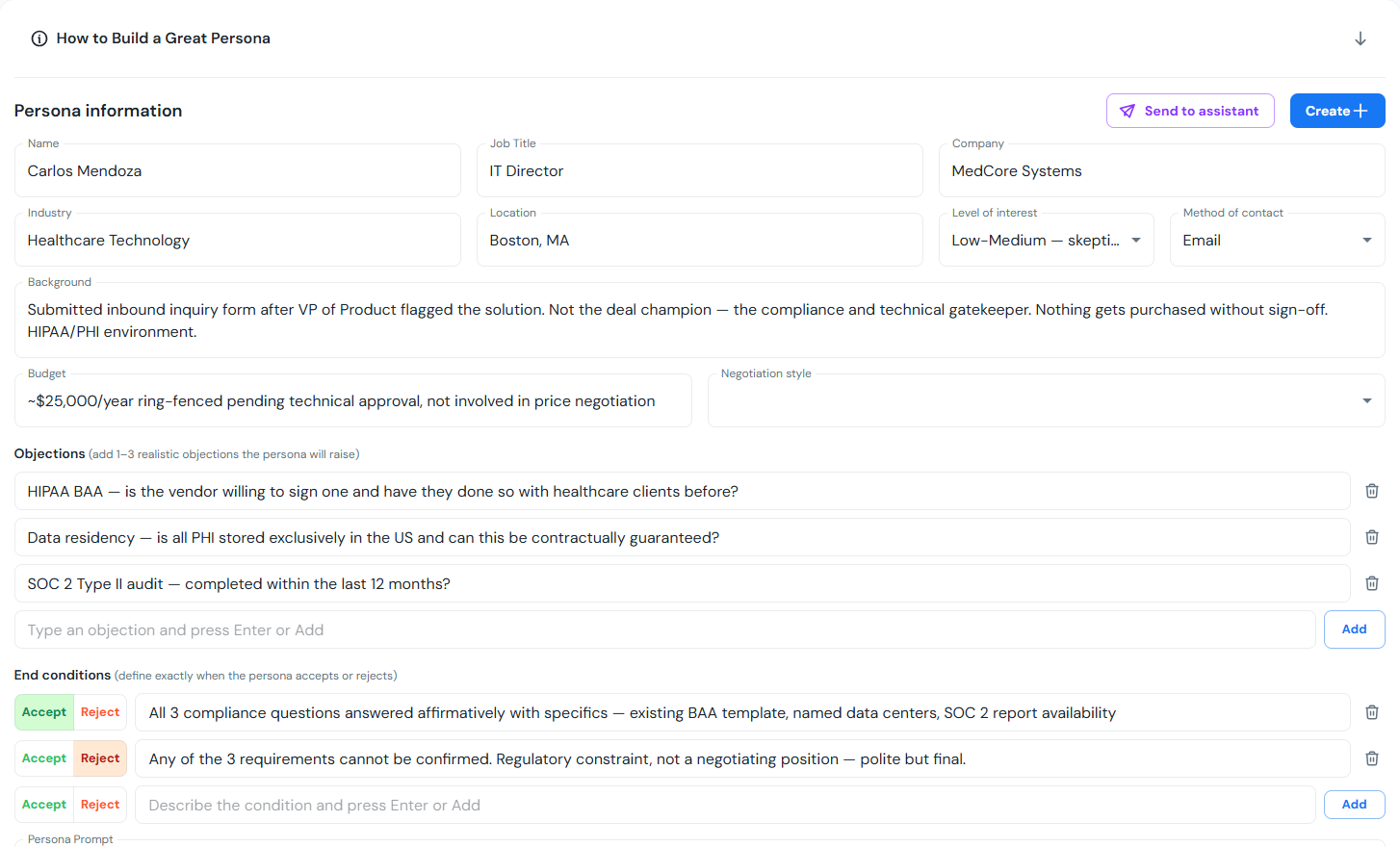 Every persona in ST300 has defined objections and precise accept/reject conditions — making simulations realistic, not generic.
No social stakes is the AI's natural condition. The system is not a manager. It's not a colleague. It has no memory of the rep outside the current session and no opinion of them beyond what the scoring metrics produce. A rep can fumble the value proposition, recover badly, and lose the scenario — and nothing happens except a score and a set of corrections. That structural absence of judgment is what makes the practice environment actually safe, rather than nominally safe.
Objective scoring happens at the message level. Every message the rep sends during a simulation is scored across configurable metrics — clarity, objection handling, value articulation, pacing, and others depending on what the team is focused on. Where a message underperforms, the rep gets a specific correction: this is the message, this is the problem, this is what you should have said instead. That granularity is not achievable through human observation at any realistic scale.
Repeatability is unlimited. A rep can run the same scenario as many times as they want, back to back, with no additional cost to the manager's time. Scores accumulate into trend lines. The manager sees improvement — or the absence of it — over time and across the team. For the first time, there's a longitudinal record of how communication skills are developing, not just a set of one-off impressions from periodic role-play sessions.
The Practice Environment Is the Product
Sales teams invest heavily in methodology: the right framework, the right objection-handling script, the right discovery questions. Most of that investment is not wrong. The frameworks are often solid.
The gap is practice. Specifically, the gap is a practice environment that lets reps build skill through repetition, failure, and specific correction, without the social dynamics that make real practice impossible in most team settings.
If your team is selling internationally in English and the main practice method is role-play with colleagues, the methodology isn't the bottleneck. The practice environment is.
Free trial available now at st300.octagrid.net no credit card required. Set up a persona, run a simulation, and see exactly where your reps' conversations are breaking down.
Copyright © Sales Trainer 300 2026