
Why Your Sales Reps Aren't Improving (And What to Do About It)
When a deal goes quiet, you rarely find out why. The prospect doesn't call back to say your rep talked past the objection, or rushed to pricing before building value, or used filler phrases that signalled uncertainty. They just stop responding. The feedback gap is almost total — and it sits at the centre of why so many sales training programs fail to move the needle.
Managers work with outcome data: win rates, pipeline coverage, average deal size. Those numbers tell you what happened. They don't tell you where in the conversation things broke down, or which specific habits are costing your team deals. Without that, coaching is guesswork. You improve what you can measure, and most companies aren't measuring how their reps actually communicate.
This is the problem worth solving. Not the lack of frameworks — there's no shortage of sales methodology. The problem is the gap between knowing how to sell and being able to execute it consistently, under pressure, in a live conversation.
Why Traditional Sales Training Doesn't Work
Most sales training programs have three structural problems that limit their effectiveness regardless of the quality of the content.
The first is passive learning. Courses, videos, and workshops are useful for introducing frameworks. But knowing a framework and executing it under pressure are completely different skills. You cannot watch your way to competence. A rep who has studied objection handling in a course still has to navigate a real conversation in real time, where the prospect is saying something unexpected and there's no pause button. Passive learning builds knowledge. It doesn't build skill.
The second is the absence of measurement. Most companies have no baseline data on how their reps communicate. Is your team asking good discovery questions? Are they handling pricing objections with confidence? Are they adapting their message to different buyer types? Most sales directors can't answer those questions with data. They're coaching from instinct and experience — which is valuable, but it's not scalable and it's not objective. Without a measurement baseline, you can't know whether your training investment is producing any improvement at all.
The third is the coaching bottleneck. Expert coaching works. The problem is supply. A sales manager has a full-time job running deals, managing pipeline, and reporting upward. Doing meaningful, structured role-play with every rep on the team — every week, with real feedback — is not realistic. In practice, most reps get very little structured coaching. They learn on the job, which means they learn slowly, and they learn by losing deals first.
These three problems compound each other. Without measurement, you don't know who needs coaching most. Without coaching capacity, even the reps you've identified can't get enough practice. And without active practice, the frameworks you taught in training don't transfer into real execution.
Why Role-Play with Colleagues Doesn't Fix It
The standard solution is role-play — pair reps up, have one play the prospect, debrief afterward. It sounds practical. In reality, it has a persistent set of problems that limits its effectiveness.
When a rep knows they're being watched — by a manager or a peer — they perform. They bring their best version of the pitch. They don't fumble the value proposition. They don't go blank when pushed on pricing. The practice environment produces behaviour that doesn't reflect what happens in an actual sales call, which means the feedback you collect isn't grounded in the real problem.
When colleagues are giving feedback, they soften it. No one wants to tell a teammate that their discovery questions are weak or that they sounded defensive when challenged. The social dynamics of a team push feedback toward the diplomatic and the vague. "That was pretty good, maybe just be a bit more confident" isn't a correction — it's noise.
This dynamic is especially acute in APAC markets. In Japan and across much of Southeast Asia, the social cost of being seen to fail in front of peers or managers is high. Face-saving culture shapes how people behave in evaluative situations. Reps don't just want to avoid the feedback — they want to avoid the exposure. The result is that role-play sessions produce even less authentic behaviour than they would in other markets, and the feedback loop is even further distorted.
What Effective Practice Actually Requires
There's a well-established body of thinking around what separates effective deliberate practice from going through the motions. The research points consistently to a few conditions that have to be present for skill to actually develop.
The first is repetition in a safe environment — one where failing doesn't carry a social or professional cost. People improve faster when they can attempt something, get it wrong, understand why, and try again immediately. Most sales practice environments don't provide this.
The second is specific feedback on specific moments. Not general impressions. Not "you could have been more persuasive." The rep needs to know which message caused the problem, why it caused the problem, and what a better version would look like. That level of specificity is extremely hard for a human coach to deliver at scale across an entire team.
The third is progressive difficulty. Reps who only practice against the same scenario stop improving. The challenge has to increase as the skill develops — harder personas, tighter objections, faster-paced conversations.
The fourth is tracking improvement over time. Feedback is only useful if you can see whether it's being acted on. Without longitudinal data, you can't tell whether a rep is improving, plateauing, or regressing.
Traditional training methods fail to provide most of these. Role-play is inconsistent on feedback quality, difficult to repeat at scale, and produces no trackable data. Courses provide no practice at all.
What Changes When the Social Cost of Failure Is Removed
When reps practice in an environment where there's no judgment, behaviour changes. They try things they wouldn't attempt in front of a manager. They run the pitch they're less confident in. They take risks and recover from them.
This isn't a secondary benefit — it's the core mechanism that makes practice actually work. Skill develops through failure and correction, repeated often enough that the correction becomes automatic. You can't get there if the practice environment suppresses failure.
For teams selling in English across APAC — where many reps are working in their second or third language, and where the cultural pressure to appear competent is high — this matters even more. The AI doesn't care if a rep stumbles over a phrase or loses control of the conversation. It scores what happened and tells them what to do differently. That's all. There's no awkward debrief, no manager who saw the weak moment, no colleague who'll remember it at the next team meeting.
How ST300 Addresses Each Gap
ST300 is built around the specific problems described above — not as a feature list, but as a direct structural response to each one.
The passive learning problem is addressed by making practice active and mandatory. There's no video to watch. The rep is in a live conversation with an AI-generated prospect who is running a realistic scenario with defined objections and accept/reject conditions. They have to respond. There's no way to absorb this passively.
The measurement problem is addressed by scoring every session across up to eight configurable metrics — things like clarity, objection handling, value articulation, and pacing. Those scores accumulate over time. Managers get trend lines per rep and team comparison data. For the first time, there's a baseline, and there's a way to see whether it's moving.
The coaching bottleneck is addressed by delivering feedback at the message level after every single session — automatically. Every message a rep sends during a simulation is flagged, scored, and corrected if it underperforms. The correction is specific: this is the message, this is what was wrong, this is what you should have said instead. That's the equivalent of a coaching session after every practice run, for every rep, without any additional time from the manager.
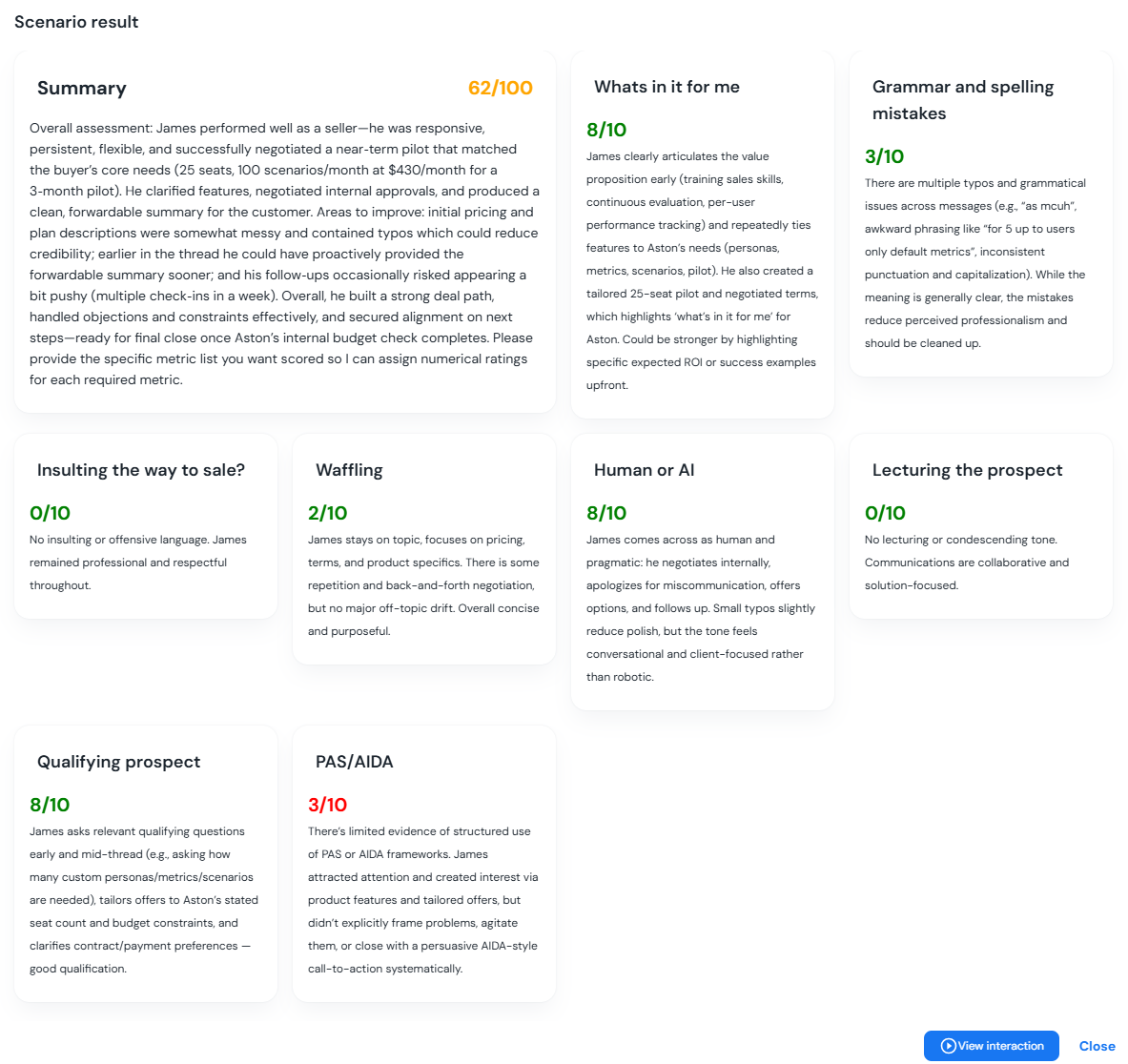 ST300 scores every message after a simulation — here's what a real result looks like.
The social cost problem is addressed by removing the human audience entirely. The AI is not the rep's manager. It's not their colleague. It's not a prospect whose opinion of them matters. It's a system that scores performance and tells them how to improve. Reps can fail in front of it as many times as they need to — and that's exactly the point.
Where to Start
If your sales team is selling internationally in English and you're not measuring how they actually communicate — not win rates, but the quality of the conversation itself — this is the gap worth closing.
The practice environment matters as much as the framework you're teaching. Reps need volume, specificity, and safety. Most training programs provide none of those things consistently.
Free trial available now at st300.octagrid.net — no credit card required. The first simulation takes a few minutes to set up and run.
Copyright © Sales Trainer 300 2026